

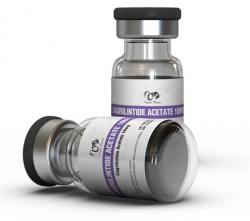
Cagrilintide Acetate is an amylin-analog, now being developed in combination with the GLP-1 agonist semaglutide to achieve sustained weight loss in persons with overweight and obesity.
Amylin, released with insulin from beta cells in the pancreas, induces its satiating effect via both the homoeostatic and hedonic regions of the brain. Semaglutide, a GLP-1 receptor agonist, reduces appetite via GLP-1 receptors in the hypothalamus and increases the production of insulin, and reduces glucagon secretion, delaying gastric emptying. These separate, but related mechanisms of action of an amylin-analog and a GLP-1 receptor agonist appear to have an additive effect on appetite reduction. Given the heterogeneity and complex pathogenesis of obesity, combination therapy with multiple pathophysiological targets is a logical approach to increasing weight loss response with pharmacotherapy.
Cagrilintide Acetate alone, as well as cagrilintide in combination with semaglutide have shown promising weight loss in clinical trials that supports the further development of this therapy for sustained weight management.
Introduction
Cagrilintide Acetate has attracted significant attention in metabolic-health research because it represents a different approach to weight management from medicines that primarily target the GLP-1 pathway. It is an analogue of amylin, a naturally occurring hormone involved in appetite regulation, food intake, and metabolic control. Researchers have been investigating whether activating amylin pathways can help people achieve meaningful and sustained reductions in body weight.
Interest in this compound has increased considerably because clinical research has produced encouraging findings both with cagrilintide alone and, particularly, when it is combined with semaglutide. Importantly, these results should be interpreted in the context of clinical trials rather than as proof that an unapproved product purchased outside a regulated medical system is safe or effective.
The development of Cagrilintide Acetate is especially interesting because obesity is a complex chronic condition influenced by appetite, energy balance, metabolism, genetics, environment, and behavior. A medicine that influences appetite through a complementary biological pathway could potentially become an important addition to the treatment landscape.
What Is Cagrilintide Acetate?
Cagrilintide Acetate refers to the acetate salt form of cagrilintide, a long-acting amylin analogue being developed for weight management. Amylin is naturally produced by pancreatic beta cells alongside insulin and contributes to the regulation of eating behavior and glucose metabolism.
Rather than functioning as a traditional stimulant or fat-burning compound, cagrilintide is designed to mimic important effects of amylin. Research suggests that amylin signaling can influence appetite and food intake, potentially helping individuals consume less food and maintain a lower energy intake.
This distinction is important. The compound is not simply intended to increase calorie expenditure. Its proposed therapeutic value is closely connected to appetite regulation and the biological systems that influence satiety.
The development of cagrilintide has also generated substantial interest because it may complement medicines that work through other pathways. The most extensively studied example is its combination with semaglutide, known as CagriSema.
How Does It Work?
The biological action of cagrilintide is centered on amylin receptors. Amylin plays several roles in normal physiology, including slowing gastric emptying, increasing feelings of fullness, and helping regulate food intake.
By activating relevant amylin pathways, cagrilintide is being studied for its potential to reduce appetite and promote sustained weight reduction.
This mechanism is different from that of semaglutide. Semaglutide is a GLP-1 receptor agonist, while cagrilintide is an amylin analogue. Researchers therefore became interested in whether targeting both pathways could provide complementary effects.
That concept is particularly important in obesity research because the body has powerful biological mechanisms that promote weight regain after weight loss. Addressing appetite and satiety signaling through more than one pathway may potentially help overcome some of these adaptations.
However, mechanism alone does not establish clinical effectiveness. A compound can have an attractive biological rationale while still requiring extensive clinical testing to establish its benefits, risks, appropriate dosing, long-term safety, and place in medical practice.
Potential Importance for Weight Management
The importance of Cagrilintide Acetate research is closely connected to the increasing recognition of obesity as a chronic disease rather than simply a consequence of lifestyle choices.
Excess body weight is associated with numerous health risks, including cardiovascular disease, type 2 diabetes, hypertension, sleep-related breathing disorders, fatty liver disease, and other metabolic complications. Consequently, effective weight-management treatments can have implications beyond appearance or body size.
Clinical research has provided evidence that cagrilintide can contribute to weight reduction. A sub-analysis of the phase 3 REDEFINE 1 trial reported an average body-weight reduction of 11.8% after 68 weeks with cagrilintide 2.4 mg among participants adhering to treatment, compared with 2.3% with placebo. Novo Nordisk subsequently moved cagrilintide into its RENEW phase 3 program.
These findings are encouraging, but they should not be interpreted as guaranteeing that an individual will experience the same degree of weight loss.
How Effective Is It?
When discussing the effectiveness of Cagrilintide Acetate, it is important to distinguish between cagrilintide by itself and the cagrilintide-semaglutide combination.
In the REDEFINE 1 clinical trial, cagrilintide was studied alongside semaglutide and placebo in adults with overweight or obesity. The combination produced substantially greater weight loss than placebo. At 68 weeks, the estimated mean body-weight change was -20.4% with cagrilintide-semaglutide compared with -3.0% with placebo.
The trial included 3,417 participants and also found that people receiving the combination were more likely to achieve weight-loss thresholds of 5%, 20%, 25%, and 30%.
Those results demonstrate why the amylin pathway has generated considerable scientific interest. Nevertheless, the results apply specifically to the studied treatment regimen and clinical-trial population. They should not be used to claim that cagrilintide alone produces the same degree of weight loss.
Research has also continued into populations with type 2 diabetes. In REDEFINE 2, once-weekly cagrilintide-semaglutide produced an estimated mean body-weight reduction of 13.7% at week 68 compared with 3.4% with placebo.
More recent research in East Asian populations has similarly reported significant weight reduction with the combination compared with semaglutide alone. In REDEFINE 5, the estimated mean change at week 68 was -18.4% with cagrilintide-semaglutide versus -11.9% with semaglutide.
These studies strengthen the evidence supporting continued investigation of the amylin pathway, while also demonstrating why individual trial results need to be considered separately.
Why the Amylin Pathway Matters
One of the most interesting characteristics of Cagrilintide Acetate is its relationship with the body’s natural satiety system.
Weight loss can be difficult to maintain because appetite-regulating mechanisms may respond to reduced body weight by increasing hunger and encouraging greater food intake. Treatments that influence satiety pathways may therefore have a role in helping people manage these biological pressures.
Amylin is particularly relevant because it is naturally involved in meal-related satiety. Its effects include reducing food intake and slowing gastric emptying. Cagrilintide is designed to provide a longer-acting pharmacological version of this type of signaling.
This does not mean that it should be considered a conventional appetite suppressant. Its pharmacology is more specific, and its clinical development is focused on medically supervised treatment rather than recreational or cosmetic use.
Potential Benefits Under Investigation
The potential benefits being studied include:
- Reduced appetite: Amylin signaling may increase satiety and reduce food intake.
- Body-weight reduction: Clinical trials have demonstrated meaningful weight reduction with cagrilintide and especially with cagrilintide-semaglutide.
- Potential metabolic benefits: Weight reduction itself can improve several cardiometabolic risk factors.
- Complementary activity: Its amylin mechanism may complement GLP-1 receptor agonism.
- Long-term weight-management potential: Ongoing phase 3 research is intended to establish whether the benefits can be sustained safely over time.
Research involving CagriSema has also reported improvements in cardiovascular risk factors. For example, an analysis of REDEFINE 1 found greater reductions in blood pressure with CagriSema than placebo.
However, these findings should not be interpreted as establishing that cagrilintide itself independently prevents cardiovascular events. Such conclusions require appropriate outcome trials.
Cagrilintide and Semaglutide
The combination of cagrilintide and semaglutide is one of the most important areas of current research.
Semaglutide activates the GLP-1 receptor, while cagrilintide targets amylin-related pathways. The two mechanisms may therefore address appetite and metabolic regulation from complementary directions.
The clinical results have been substantial. In REDEFINE 1, the combination achieved a 20.4% estimated mean reduction in body weight after 68 weeks, compared with 3.0% with placebo.
The combination has continued to be evaluated in additional phase 3 trials. Novo Nordisk reported in February 2026 that CagriSema produced 23.0% weight loss after 84 weeks in an open-label head-to-head study against tirzepatide, although it did not meet the trial’s primary non-inferiority endpoint.
That distinction is crucial for accurate product information: promising weight-loss numbers do not automatically mean that one treatment is superior to another.
Safety and Possible Side Effects
Safety is one of the most important considerations when evaluating Cagrilintide Acetate.
Clinical trials have reported gastrointestinal adverse events with cagrilintide-containing treatments. Depending on the study and treatment combination, reported effects have included nausea, vomiting, diarrhea, constipation, and abdominal discomfort.
In REDEFINE 1, gastrointestinal adverse events occurred in 79.6% of participants receiving CagriSema compared with 39.9% receiving placebo; the investigators reported that these events were mainly transient and mild to moderate.
The safety profile of a research compound should never be inferred from online product listings or anecdotal reports. Purity, identity, concentration, sterility, storage conditions, manufacturing standards, and actual contents can vary significantly among products obtained outside approved pharmaceutical channels.
Anyone considering an investigational medicine should discuss the potential risks and alternatives with a qualified healthcare professional.
Is It Approved?
The regulatory status of Cagrilintide Acetate is an essential part of any responsible product description.
Cagrilintide has been undergoing clinical development and is not equivalent to an already approved prescription medicine simply because clinical trials have produced promising results. Novo Nordisk’s published materials describe cagrilintide as being investigated in the RENEW phase 3 program, with trials designed to further establish its efficacy and safety.
Therefore, consumers should be cautious about websites that describe research-grade cagrilintide as though it were an approved weight-loss prescription or guarantee specific outcomes.
For authoritative information about clinical studies, readers can consult ClinicalTrials.gov and PubMed.
Who Is the Research Most Relevant To?
The clinical studies have primarily focused on adults with overweight or obesity, including people with obesity-related health complications and, in some trials, people with type 2 diabetes.
The appropriate use of any future approved cagrilintide product would ultimately depend on the indications, regulatory approvals, dosing instructions, contraindications, and prescribing information established by regulatory authorities.
It would be inappropriate to assume that an investigational compound is suitable for every person seeking weight loss.
Pregnant individuals, people with significant medical conditions, people taking other medications, and individuals with a history of serious medication reactions require individualized medical assessment before considering any weight-management pharmacotherapy.
What Makes This Compound Different?
The most distinctive feature of Cagrilintide Acetate is its amylin-based mechanism.
Many modern obesity medicines focus on incretin biology, particularly GLP-1 signaling. Cagrilintide introduces another biological pathway associated with appetite and satiety. This creates the possibility of complementary treatment strategies rather than relying on a single mechanism.
The clinical evidence surrounding CagriSema illustrates the potential of this strategy. At the same time, the research demonstrates why combination results should not automatically be attributed to cagrilintide alone.
The distinction between a compound’s scientific potential and its established clinical indication is essential for responsible medical communication.
Research and Future Development
Current development is focused on determining whether cagrilintide can provide clinically meaningful and sustainable weight reduction while maintaining an acceptable safety profile.
Novo Nordisk has reported that the RENEW phase 3 program is investigating cagrilintide 2.4 mg in people with obesity, including separate studies involving people with and without type 2 diabetes.
Future research will be particularly important for understanding long-term outcomes, maintenance of weight loss, cardiovascular effects, safety in different populations, and how cagrilintide compares with other established therapies.
Additional research may also clarify whether different doses or treatment combinations can improve efficacy while maintaining tolerability.
Final Assessment
Overall, Cagrilintide Acetate is an intriguing investigational compound with a scientifically distinctive mechanism and an increasingly substantial clinical evidence base.
The research so far suggests that targeting amylin pathways can contribute to clinically meaningful weight reduction. The strongest results have emerged from the combination of cagrilintide with semaglutide, where large phase 3 studies have demonstrated significant reductions in body weight compared with placebo.
At the same time, it is important not to overstate the evidence. Cagrilintide should not be described as a guaranteed weight-loss solution, a muscle-building drug, or a universally safe alternative to approved therapies. Its long-term clinical role continues to be determined through research.
For consumers, the most important takeaway is that the compound’s potential is scientifically promising, but responsible use depends on regulatory status, clinical evidence, product quality, and professional medical supervision.
Reviews
There are no reviews yet.