

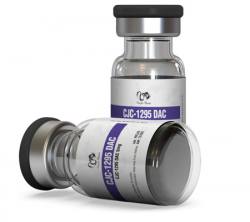
CJC-1295 peptide with DAC, also known as DAC:GRF, is a synthetic mimic of a portion of naturally produced growth hormone releasing hormone (GHRH). The CJC-1295 with DAC peptide chemistry is based around the first 29 building blocks of endogenously produced GHRH, as these first 29 amino acids provide full biological activity.
However, this peptide has been modified further by substituting four amino acids to increase its stability and potency compared to previous CJC-1295 without DAC. These four amino acids allow the peptide to bind permanently to the protein albumin inside the body, which reduces degradation and oxidation of the peptide to increase its stability. Furthermore, these additional amino acids increase the binding affinity to the GHRH receptor to increase potency. GHRH is necessary for natural growth hormone secretion and is also needed to achieve optimal natural growth during development.
CJC-1295 works by stimulating growth hormone secretion by binding to GHRH receptors and should stimulate the secretion of the whole family of growth hormone peptides normally secreted by the pituitary gland. These hormones will stimulate increases in bone density and collagen production, as well as boosting the immune system. They will also stimulate the production of lean muscle mass.
CJC-1295 with DAC can be combined with growth hormone releasing peptides for enhanced peptide cycling results. CJC-1295 DAC is commonly paired with growth hormone replacement peptide (GHRP) 6 or GHRP-2. Combined use of CJC-1295 DAC with GHRP’s will accelerate fat loss and weight loss and stimulate anabolic effects via growth hormone induced fat breakdown. Overall, CJC-1295 with DAC will stimulate protein synthesis and fuel the growth of lean muscle tissue. The peptide also promotes faster injury recovery, a reduction in body fat and increased muscle mass. The growth stimulatory properties of CJC-1295 DAC will also stimulate cell growth and division to improve skin health, healing and immune system function.
This peptide should not be confused with CJC-1295 without DAC as the chemical properties are very different and will affect dosing. CJC-1295 DAC has a half-life of around 8 days following injection. CJC-1295 with DAC injections should be subcutaneous and the peptide can be injected once per week at doses of 100 mcg or 200 mcg due to its extended half-life. This CJC-1295 DAC peptide cycling strategy will provide a prolonged overall increase in growth hormone. A weekly injection of CJC-1295 with DAC can be coupled (stacked) with other GHRPs, such as GHRP-6 or GHRP-2.
Many researchers have documented the growth-promoting effects and safety of GHRH administered to children with growth hormone deficiency. Multiple treatment regimes, including intravenous pulses, intranasal delivery, subcutaneous injections, and continuous infusion have been tested to show that the growth-promoting effect of GHRH is connected with the dose amount and frequency. No unexpected adverse reactions have been seen after prolonged treatment, regardless of the mode of administration. However, some minor side effects may occur, including tiredness, euphoria (head rush), water retention, tingling and numbness. Following the recommended dosage will minimise the risk of side effects.
CJC-1295 Dac is an investigational long-acting peptide related to growth hormone-releasing hormone (GHRH). It has attracted attention because early human research found that it can increase growth hormone (GH) and insulin-like growth factor 1 (IGF-1) for substantially longer than naturally occurring GHRH. That pharmacological feature is the main reason researchers have studied it as a possible treatment approach for conditions involving inadequate GH secretion.
However, an evidence-based product description needs an important qualification: CJC-1295 Dac is not an FDA-approved medicine, and it should not be presented as a proven treatment for muscle growth, fat loss, anti-aging, athletic performance, or other consumer goals. The FDA has specifically evaluated CJC-1295-related substances in the context of growth hormone deficiency and has stated that none of the evaluated substances is a component of an FDA-approved drug. The agency has also identified safety concerns and limited clinical data.
What is CJC-1295 Dac?
CJC-1295 Dac is a modified GHRH analog. “DAC” refers to the Drug Affinity Complex, a modification designed to increase the peptide’s association with albumin in the bloodstream and thereby extend its persistence. In contrast with short-acting GHRH signals, the long-acting design allows the compound to influence the GH–IGF-1 axis over a much longer period.
The distinction between mechanism and proven clinical benefit is important. A compound can change a hormone level without necessarily producing a clinically meaningful improvement in a person’s health or body composition. For that reason, early pharmacology findings should not be treated as proof that the product delivers the outcomes often claimed in bodybuilding or wellness marketing.
The U.S. National Library of Medicine records CJC-1295 as a protein substance, and published research describes it as a long-acting analog of GHRH.
How does it work?
CJC-1295 Dac is designed to stimulate the pituitary gland through the GHRH pathway. GHRH is a natural hypothalamic hormone that signals the pituitary to release GH. GH then contributes to downstream production of IGF-1, particularly in the liver. Together, these hormones influence growth, tissue metabolism, protein synthesis, bone biology, and other physiological processes.
A key feature of the compound is its prolonged action. In a randomized, placebo-controlled human study, a single administration produced dose-dependent increases in mean plasma GH concentrations for six days or more and increased IGF-1 for approximately nine to eleven days. The estimated half-life was about 5.8 to 8.1 days. With repeated administrations, IGF-1 remained above baseline for as long as 28 days in the study.
These findings explain why researchers became interested in the molecule. Rather than supplying growth hormone directly, the approach attempts to stimulate the body’s own GH secretion through the GHRH pathway. Another human study found that GH secretion remained pulsatile after administration, while trough GH and mean GH increased and IGF-1 also increased.
Why is it important?
The scientific importance of CJC-1295 Dac is mainly related to its ability to produce prolonged changes in the GH–IGF-1 axis. That makes it useful as an investigational tool for understanding how sustained GHRH signaling affects hormone secretion.
For legitimate medical research, this distinction matters. Researchers are interested in whether manipulating endogenous GH secretion could eventually have therapeutic value in carefully selected patients. The FDA’s 2024 Pharmacy Compounding Advisory Committee materials show that CJC-1295-related substances were evaluated in connection with growth hormone deficiency, rather than being established as general-purpose wellness or performance medicines.
For consumers, however, the importance should be framed more cautiously. Higher GH or IGF-1 numbers are not automatically better. These hormones have complex effects, and excessive or inappropriate stimulation can create undesirable metabolic and fluid-related effects. A laboratory increase therefore cannot be equated with guaranteed muscle gain, fat loss, improved recovery, or rejuvenation.
Potential effectiveness: what does the evidence show?
The strongest evidence comes from small early-phase human studies rather than large modern trials demonstrating long-term clinical outcomes.
The 2006 randomized studies included healthy adults and examined pharmacokinetics, GH, IGF-1, and tolerability. After a single dose, average GH concentrations rose approximately two- to tenfold for six days or longer, while IGF-1 increased about 1.5- to threefold for nine to eleven days. Repeated dosing produced sustained IGF-1 elevation. These are meaningful pharmacodynamic findings because they demonstrate that the molecule can alter the targeted hormonal pathway in humans.
But effectiveness should be interpreted in the context of the study population and endpoints. The research was not a large trial proving improved muscle mass, athletic performance, longevity, or general quality of life. It primarily demonstrated biological activity and pharmacokinetic persistence.
That is why claims such as “guaranteed muscle growth,” “rapid fat burning,” or “anti-aging breakthrough” go beyond the available clinical evidence. A responsible product description should separate what has actually been observed from what remains hypothetical.
Possible relevance to muscle and body composition
The GH–IGF-1 pathway is relevant to muscle and connective-tissue biology, which helps explain the interest in the compound among people focused on physique and performance. GH and IGF-1 participate in processes involving protein metabolism, tissue growth, and recovery. Nevertheless, the existence of a biological pathway does not prove that using an unapproved peptide will produce a predictable increase in muscle mass.
There is another important point: studies showing increased circulating GH or IGF-1 do not automatically establish the same magnitude of effect on body composition. Muscle growth depends on resistance training, adequate nutrition, sleep, genetics, endocrine health, and many other factors. In people without a diagnosed hormonal disorder, deliberately altering the GH–IGF-1 axis can introduce risks without providing a proven net benefit.
Accordingly, CJC-1295 Dac should not be described as an established muscle-building medication. Its potential role in this area remains investigational.
Potential relevance to men and women
The underlying GH–IGF-1 system exists in both men and women, so the biological mechanism is not exclusive to one sex. However, that does not mean the same dose, response, safety profile, or clinical outcome can be assumed for everyone.
The available early research was conducted in relatively small groups, including healthy adults, and does not provide enough evidence to establish broad sex-specific effectiveness. Hormonal physiology varies with age, sex, body composition, estrogen status, and underlying endocrine conditions. Consequently, marketing language that promises identical benefits for all men and women is not supported by the evidence.
For anyone considering an investigational peptide, the more important question is not whether it is marketed for men or women, but whether there is a medically justified indication and adequate clinical evidence for that individual.
Safety and possible concerns
Safety is one of the most important parts of any discussion of CJC-1295 Dac. Early clinical research reported no serious adverse reactions in the particular trials studied, but that does not establish long-term safety. The studies were small and relatively short, while widespread consumer use can involve products of uncertain quality, formulation, sterility, identity, and concentration.
The FDA currently lists CJC-1295 among compounded substances that may present significant safety risks. The agency notes concerns involving immunogenicity, peptide-related impurities and difficulties in characterizing peptide substances. It also reports serious adverse events associated with CJC-1295, including increased heart rate and systemic vasodilatory reaction, while emphasizing that available clinical data are limited.
Because the GH–IGF-1 axis influences multiple tissues and metabolic processes, inappropriate stimulation can have consequences beyond the intended effect. People with endocrine disorders, diabetes or glucose-regulation problems, cancer-related concerns, cardiovascular conditions, or other significant medical issues should not assume that an experimental hormone-modulating peptide is appropriate for them.
Product quality is another major issue. A laboratory or online “research peptide” is not equivalent to an approved pharmaceutical product. The label may not guarantee purity, sterility, identity, or accurate concentration. Injectable products carry additional risks if manufacturing and handling standards are inadequate.
Is it FDA approved?
No. CJC-1295 Dac should not be marketed as an FDA-approved drug. In its 2024 evaluation, the FDA stated that none of the CJC-1295-related substances it reviewed was a component of an FDA-approved drug.
The FDA explains that approved drugs must undergo a development and review process designed to establish safety and effectiveness for specific intended uses. Consumers can verify approved human medicines through FDA databases such as Drugs@FDA and the Orange Book.
This regulatory status is especially important for online product descriptions. Words such as “pharmaceutical,” “clinically proven,” or “FDA approved” should not be used unless they can be substantiated for the exact product and indication.
What makes the DAC version different?
The defining feature of CJC-1295 Dac is its long-acting design. The Drug Affinity Complex enables the molecule to associate with albumin, helping extend its circulation time. This is pharmacologically different from short-acting GHRH analogs.
The prolonged exposure can be scientifically useful because it allows researchers to investigate sustained stimulation of GH secretion. In the published human studies, the effect on GH and IGF-1 lasted for days rather than only a short period. That prolonged profile is the central feature that distinguishes the DAC formulation from approaches intended to produce brief hormonal pulses.
However, longer activity is not synonymous with greater clinical benefit. It can also mean that an unwanted effect may persist longer. This is another reason why the pharmacology should be considered together with medical supervision and safety data.
Who should be cautious?
Anyone considering CJC-1295 Dac outside a properly regulated clinical research or medical setting should exercise substantial caution. Particular concern is warranted for people with conditions that could be affected by altered glucose metabolism, fluid balance, cardiovascular function, or abnormal tissue growth.
It is also important to distinguish a diagnosed growth hormone disorder from a desire to optimize an already normal hormone level. Treatment of a genuine endocrine deficiency is a medical question that requires clinical assessment and laboratory testing. Using an experimental peptide for physique enhancement is a different situation and has a much weaker evidence base.
If a clinician is evaluating suspected GH deficiency, the appropriate path is endocrine assessment rather than relying on online claims about peptide products.
How should a product description present it?
A high-quality product description should be accurate about what is known, transparent about what is uncertain, and careful not to promise outcomes that clinical trials have not established.
For CJC-1295 Dac, the strongest evidence-based statements are that it is a long-acting GHRH analog, that human studies demonstrated sustained increases in GH and IGF-1, and that it remains investigational rather than an FDA-approved medicine. Those facts make the compound scientifically interesting without exaggerating its clinical value.
A responsible description should avoid recommending self-injection, giving individualized dosing instructions, or presenting bodybuilding protocols as medical guidance. It should also avoid claiming that the compound is proven to build muscle, burn fat, reverse aging, or improve athletic performance.
Final assessment
CJC-1295 Dac is scientifically interesting because it was designed to provide prolonged stimulation of the GHRH pathway. Early human research demonstrates that it can substantially increase GH and IGF-1 and that these hormonal effects can persist for days or, with repeated exposure, longer. Those findings establish pharmacological activity, not a guarantee of therapeutic or cosmetic effectiveness.
The most important takeaway is that CJC-1295 Dac occupies an investigational space. It is not an FDA-approved component of an approved drug, and the FDA has highlighted limited clinical data and safety concerns surrounding CJC-1295-related compounded substances. For that reason, it should not be presented as a proven treatment or a guaranteed performance-enhancing product.
For educational and SEO purposes, the most accurate positioning is therefore as an investigational long-acting GHRH analog with demonstrated effects on the GH–IGF-1 axis and uncertain long-term clinical benefits. Anyone considering use should discuss the risks, alternatives, and evidence with a qualified healthcare professional rather than relying on promotional claims.
Reviews
There are no reviews yet.