

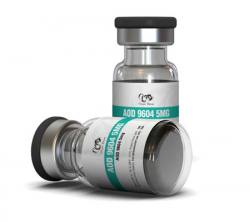
AOD 9604 (HGH Lipolytic Fragment) is a peptide fragment of the C-terminus of Human Growth Hormone. It has an ability to stimulate lipolytic (fat burning) and anti-lipogenic activity.AOD9604 (HGH Lipolytic Fragment) acts on the reduction of excessive adipose tissues such as those in the abdominal area, increase in muscle mass, and enhances the lipid content of the body.
AOD 9604 (HGH Lipolytic Fragment) benefits are: Reduces body fat. Mimics the way natural growth hormone regulates fat metabolism. Inhibits lipogenesis that’s the transformation of non-fatty foods into body fat. No adverse effects on blood sugar or growth. Stimulates lipolysis.
AOD 9604 (HGH Lipolytic Fragment) works by mimicking the way natural Growth Hormone regulates fat metabolism but without the adverse effects on blood sugar or growth that is seen with unmodified Growth Hormone.
There is no stipulated dosage of this drug, it’s injected the dosage of 300 mcg/day given at bedtime. Inject it into the body fat around the stomach area.
You can use bacteriostatic water or sterile water. Take the lids off both your water and AOD 9604 (HGH Lipolytic Fragment) containers. Use a fresh alcohol swab to clean the area of injection and the rubber stopper of your AOD 9604 (HGH Lipolytic Fragment) bottle and the top of the water vial and allow each to air dry. Fill the insulin syringe with 1 ml water and slowly and carefully inject the syringe of water into the 2 mg bottle of AOD 9604 (HGH Lipolytic Fragment)– being careful to spray the water onto the sides of the container rather than directly into the powder.
Keep it in the refrigerator or freezer to preserve it until you’re ready to use it. (Usually recommend its use for 3-4 weeks, so do not leave diluted drug for a longer period even in cold environment).
Introduction
Interest in peptide-based compounds has grown rapidly as researchers continue to investigate new approaches to body-weight management, metabolism, and fat biology. One compound that has attracted considerable attention is AOD 9604, a synthetic peptide fragment derived from a specific region of human growth hormone. It has been investigated primarily for its potential effects on fat metabolism and obesity, although its development has not resulted in an FDA-approved obesity treatment.
The science surrounding this compound is particularly interesting because its proposed action is different from that of conventional appetite-suppressing medications. Rather than being developed primarily to reduce food intake, researchers investigated whether the peptide could influence the body’s handling of stored fat. Early laboratory and animal research produced encouraging findings, while human research produced more limited results.
That distinction is important. A product can have an interesting biological mechanism without having demonstrated sufficient effectiveness in large clinical trials. The FDA’s evaluation of this compound also emphasizes that it is not a component of an FDA-approved drug and raises important questions regarding safety, quality, and the appropriate use of compounded peptide products.
For anyone researching this peptide, therefore, the most useful approach is to separate established scientific evidence from marketing claims. This overview examines what it is, why researchers studied it, what the evidence suggests about effectiveness, and why appropriate medical supervision and product quality remain essential.
What Is AOD 9604?
AOD 9604 is a synthetic peptide based on a portion of human growth hormone. According to the U.S. Food and Drug Administration, it is a hexadecapeptide related to amino acids 177–191 of human growth hormone, with an additional tyrosine at the N-terminal end.
The compound was developed from research into the fat-metabolizing properties associated with a particular region of growth hormone. Researchers were interested in whether it might reproduce some potentially useful metabolic effects without producing all of the broader biological effects associated with administering full-length human growth hormone.
This distinction is scientifically significant. Human growth hormone has numerous physiological functions, including effects involving growth, metabolism, and tissue biology. A smaller peptide fragment was investigated as a more targeted approach to studying certain aspects of fat metabolism.
Early research examined whether the compound could increase lipolysis, the process through which stored triglycerides are broken down into fatty acids and glycerol. Laboratory and animal findings provided a basis for further investigation, but animal results cannot automatically be translated into equivalent effects in humans.
A peer-reviewed study published in Hormone and Metabolic Research reported that oral administration in obese Zucker rats reduced body-weight gain and increased lipolytic activity in adipose tissue. Importantly, those findings were obtained in an animal model rather than in humans, so they should be regarded as preliminary evidence rather than proof of clinical effectiveness.
Why Was This Peptide Studied?
The original scientific interest in AOD 9604 centered on obesity and fat metabolism. Researchers hoped that a compound derived from the lipolytic region of growth hormone might influence fat breakdown while avoiding some of the unwanted effects associated with long-term growth hormone exposure.
This created an appealing research hypothesis: if a smaller peptide could selectively influence pathways associated with fat metabolism, it might potentially become a useful treatment for people struggling with obesity.
The concept was especially interesting because obesity is a complex chronic condition involving energy balance, appetite regulation, hormonal signaling, metabolic adaptation, genetics, environment, and behavior. No single mechanism explains every case.
However, promising mechanisms must ultimately be tested through appropriately designed human clinical trials. The history of this peptide demonstrates exactly why this distinction matters.
Potential Effects on Fat Metabolism
One of the most frequently discussed characteristics of this peptide is its proposed relationship with lipolysis. Lipolysis refers to the breakdown of stored fat within adipose tissue.
The early animal research was encouraging. In obese Zucker rats, investigators reported increased lipolytic activity and substantially less weight gain compared with controls. The same research reported no adverse effect on insulin sensitivity in that particular animal model.
These findings helped establish the scientific rationale for investigating the compound further.
However, it would be misleading to describe these animal findings as evidence that the compound reliably produces the same effect in humans. Differences between animal models and people can be substantial, particularly when considering absorption, metabolism, dosage exposure, biological signaling, and long-term outcomes.
This is one reason clinical evidence is more important than laboratory enthusiasm when evaluating a potential weight-management therapy.
What Does the Human Evidence Show?
Human evidence has been considerably less convincing than some promotional descriptions suggest.
A review of anti-obesity pharmacotherapy research reported that a 12-week randomized clinical trial involving the peptide found an average weight reduction of approximately 2.6 kg in participants receiving 1 mg per day compared with approximately 0.8 kg in the placebo group. However, the response was not dose-dependent, with a higher-dose group showing a smaller reduction. More importantly, development was subsequently terminated after the compound failed to demonstrate significant weight loss in a 24-week trial involving 536 participants.
This is a critical part of the story.
The results suggest that the biological concept was interesting but did not translate into sufficiently consistent clinical efficacy during later development. Consequently, it would be inaccurate to describe this compound as a proven or highly effective obesity medication based on current evidence.
The FDA’s 2024 evaluation likewise considered publicly available information concerning its historical use, effectiveness, and safety in compounded products. The agency stated that the substance is not a component of an FDA-approved drug.
What Makes Its Research Interesting?
The scientific appeal of AOD 9604 comes from its relationship to the lipolytic portion of human growth hormone.
Researchers were interested in whether a smaller peptide could retain selected metabolic properties while avoiding the broader effects of intact growth hormone. This approach represents a wider concept in pharmacology: designing molecules that target particular biological pathways more selectively.
The compound’s research history therefore remains relevant even though its development for obesity did not establish it as an effective approved treatment.
It illustrates how drug development works. A promising molecular concept can move from laboratory studies into human trials, encounter unexpected limitations, and ultimately fail to meet the required clinical endpoints.
That is not a failure of science. Negative or inconclusive clinical findings are valuable because they prevent biological theories from being mistaken for proven therapies.
Effectiveness: What Should Consumers Realistically Expect?
When evaluating the effectiveness of AOD 9604, the strongest conclusion is that evidence remains insufficient to support strong claims of reliable weight loss in humans.
Early studies created optimism, and some human research showed weight reduction. However, the later 24-week clinical trial did not demonstrate significant enough benefit to continue development for obesity.
That means claims such as “guaranteed fat burning,” “rapid weight loss,” or “clinically proven superior results” are not supported by the overall evidence.
It is also important to distinguish between mechanistic potential and clinical effectiveness. A compound may influence fat metabolism in a laboratory setting while failing to produce meaningful or durable changes in body weight among diverse human populations.
Modern obesity treatments that have successfully completed rigorous clinical development are evaluated using outcomes such as percentage body-weight reduction, metabolic improvements, adverse events, and long-term tolerability. By comparison, the clinical development history of this peptide does not provide equivalent evidence of efficacy.
Safety and Quality Considerations
Safety deserves particular attention because peptide products sold outside conventional approved-drug pathways can present additional uncertainties.
In its evaluation, the FDA specifically noted that peptides have characteristics that distinguish them from many small-molecule drugs. These considerations include possible immunogenicity, peptide aggregation, peptide-related impurities, and challenges associated with characterization.
These issues matter because the identity and purity of a peptide product are not necessarily guaranteed simply because a label contains the correct chemical name.
A research chemical, compounded preparation, and approved pharmaceutical product are not interchangeable categories.
People considering an experimental or compounded peptide should therefore discuss the issue with a qualified healthcare professional who can evaluate the individual’s circumstances, potential contraindications, medication interactions, and appropriate alternatives.
Self-directed use of an unapproved peptide can make it difficult to determine whether an unexpected reaction is caused by the active substance, impurities, formulation, incorrect concentration, contamination, or another factor.
Why Product Quality Matters
Peptide quality is especially important because peptides can be sensitive to manufacturing, storage, formulation, and handling conditions.
The FDA’s review specifically highlighted concerns involving peptide characterization and impurities.
This means that a webpage claiming to sell a particular peptide should not automatically be interpreted as evidence that the product has pharmaceutical-grade quality.
Consumers should look for transparent information about the manufacturer, quality-control processes, testing, labeling, and regulatory status rather than relying solely on testimonials or before-and-after photographs.
A professional healthcare setting can also provide a more appropriate framework for evaluating whether an experimental compound has any reasonable role in an individual’s treatment plan.
AOD 9604 and Modern Weight-Management Treatments
The field of obesity treatment has changed considerably since early development of this peptide.
Today, several approved medications have undergone large randomized clinical trials and have demonstrated substantially more robust evidence for weight management. For example, contemporary GLP-1-based and related therapies have been studied in large populations with carefully defined clinical endpoints.
This does not make every newer therapy automatically superior for every individual. Different medications have different indications, benefits, risks, contraindications, costs, and tolerability profiles.
It does, however, highlight why evidence quality matters.
A treatment should ideally be judged by reproducible human clinical outcomes rather than by its proposed mechanism alone.
Is It a Muscle-Building Drug?
Another area where marketing claims can become misleading is muscle development.
AOD 9604 was investigated primarily in the context of obesity and fat metabolism, not as an established muscle-building medication. There is not sufficient clinical evidence to characterize it as a proven anabolic agent or reliable method for increasing muscle mass.
People pursuing improved body composition should remember that losing fat and gaining muscle are separate physiological objectives. Resistance training, adequate protein intake, sufficient energy availability, sleep, and evidence-based medical treatment when appropriate remain important components of body-composition management.
It would therefore be inappropriate to market this peptide as a guaranteed shortcut to a muscular physique.
Importance for Men and Women
Research involving this peptide has primarily focused on metabolic and obesity-related questions rather than establishing separate performance benefits for men and women.
Biological responses to weight-management therapies can differ between individuals because of body composition, hormones, genetics, age, concurrent medications, and other factors. Nevertheless, there is not enough evidence to claim that the compound is specifically more effective for men or specifically more effective for women.
Anyone considering an experimental peptide should receive individualized medical advice rather than assuming that a product’s advertised results apply equally to everyone.
A Balanced View of the Potential Benefits
The potential benefits that originally made this peptide scientifically interesting include its relationship to fat metabolism, its origin from a defined region of growth hormone, and early experimental findings suggesting effects on lipolysis.
Those characteristics explain why researchers investigated it.
But potential is not the same as proven effectiveness.
The most responsible description is that the compound represents an interesting experimental peptide whose development for obesity did not produce sufficiently convincing evidence for an approved treatment. Early animal research was promising, while human development ultimately failed to establish the desired clinical benefit.
That balanced interpretation is more useful than either extreme: dismissing all scientific interest or presenting the peptide as a proven weight-loss solution.
Frequently Asked Questions
Does it burn fat?
Research has investigated its potential influence on lipolysis and fat metabolism. Animal studies produced encouraging findings, but human clinical evidence did not establish a sufficiently reliable weight-loss effect for obesity development.
Is it an approved weight-loss medication?
No. The FDA states that the substance is not a component of an FDA-approved drug.
Can it replace approved obesity medications?
There is no scientific basis for recommending it as a replacement for an approved obesity treatment. Individuals should discuss evidence-based options with an appropriately qualified healthcare professional.
Is it suitable for building muscle?
It should not be described as an established muscle-building drug. Its primary research history concerns fat metabolism and obesity rather than clinically demonstrated muscle growth.
Is it proven effective?
No. Although some early studies produced promising observations, the compound ultimately failed to demonstrate sufficient weight-loss efficacy in a larger 24-week clinical trial for continued obesity development.
Final Assessment
AOD 9604 remains an interesting example of how peptide research can generate excitement while also demonstrating the importance of rigorous clinical evidence. Its scientific foundation comes from research into a lipolytic region of human growth hormone, and early animal experiments suggested potentially useful effects on fat metabolism.
However, the human evidence is much less compelling. Clinical development for obesity was discontinued after a larger trial failed to demonstrate significant weight-loss efficacy, and the FDA has stated that the substance is not a component of an FDA-approved drug.
For that reason, the most accurate product description is not that it is a guaranteed fat-burning solution, but that it is an experimental peptide with a scientifically interesting mechanism and limited evidence of clinical effectiveness.
Anyone researching peptide-based weight management should prioritize peer-reviewed human studies, regulatory information, product-quality documentation, and professional medical advice. The FDA’s official resources on approved medications and its evaluation of this peptide are useful starting points for separating established medical treatments from experimental products.


Reviews
There are no reviews yet.