
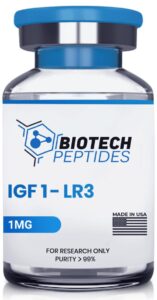
Igf-1LR3 Insulin like growth factor-1 (IGF-1) is a substance which in manufactured by recombinant DNA technology. IGF-1 is the primary mediator of the growth promoting effects of human growth hormone. As such, the substance also can stimulate the growth of bone, muscle, and internal organs. Its effects on skeletal muscle are also highly hyperplasic, meaning it causes an increase in cell number. Unlike human growth hormone, however, this substance has very strong insulin like effects. It can support growth by increasing the uptake of amino acids, glucose, and fatty acids, but lowers blood sugar levels so efficiently that it can induce severe hypoglycemia if to high of a dose is taken.
Among the other anabolic effects that IGF1 can produce in the body are things such as increasing protein synthesis, increasing nitrogen retention, as well as inducing the growth of more muscle fibers. When an appropriate amount of amino acids (protein) is available, all of these actions within the body are able to be completed.
It has been demonstrated that IGF1 can help to improve collagen production as well as the reproduction of cartilage in joints. The hormone has also been shown to exhibit the ability to act as a neuro-protector and promoter mainly because IGF1 receptors are located in the tissue of the brain. It has been demonstrated that there is a potential for when supplemented with IGF1 a decrease in the progress of some brain diseases can be brought about as well as slowing the deterioration of brain function in some elderly subjects.
In terms of dosing for IGF-1, users have reported seen good results when administering dosing ranging from 100 to 160 mcg per day. This total dose would be split into several injections, most of which would likely be administered post-workout.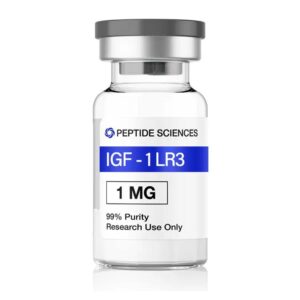
An Important Introduction
Igf-1LR3 is a laboratory-engineered analogue of insulin-like growth factor-1 (IGF-1), a naturally occurring growth factor involved in cell growth, tissue development, protein synthesis, and skeletal-muscle physiology. Because IGF-1 signaling is strongly connected with anabolic processes, the compound has attracted considerable attention within bodybuilding, sports-performance, peptide research, and experimental muscle biology.
However, it is important to distinguish the biological effects of native IGF-1 from the evidence available for the LR3 analogue. Research on IGF-1 provides substantial insight into how the IGF-1 receptor influences muscle cells, but that does not mean that the same benefits have been demonstrated in controlled human trials of Igf-1LR3. In fact, the published literature on Long R3 IGF-1 is dominated by laboratory and animal research rather than established human clinical evidence.
For anyone researching this compound, that distinction is essential. A scientifically responsible product description should explain what the molecule is, why researchers are interested in it, what biological mechanisms make it potentially relevant to muscle development, and—equally importantly—where the evidence ends.
What Is This Growth-Factor Analogue?
Igf-1LR3, commonly referred to in scientific literature as Long R3 IGF-1 or LR3-IGF-I, is a modified form of IGF-1. The modification changes the molecule’s structure in ways intended to alter how it interacts with IGF-binding proteins and its biological stability. Research has described Long R3 IGF-I as an analogue with substantially reduced affinity for IGF-binding proteins compared with native IGF-I.
This is important because naturally occurring IGF-1 does not simply circulate freely throughout the body. Much of the body’s IGF-1 is associated with binding proteins that influence its distribution, availability, and activity. Altering those interactions can change how an analogue behaves in experimental systems.
The scientific interest therefore goes beyond simply asking whether the molecule can increase muscle size. Researchers are interested in how modifications to IGF-1 affect receptor activation, cellular signaling, tissue growth, metabolism, and the interaction between growth-factor pathways.
That makes Igf-1LR3 an interesting research molecule—but it should not automatically be presented as a proven human performance-enhancing therapy.
Why IGF-1 Matters for Muscle Biology
Understanding the importance of Igf-1LR3 begins with understanding native IGF-1.
IGF-1 is one of the important signaling molecules involved in skeletal-muscle growth and maintenance. When IGF-1 interacts with the IGF-1 receptor, it activates intracellular signaling pathways including PI3K/Akt. Downstream effects involve mTOR and other pathways associated with protein synthesis, cellular survival, and muscle adaptation.
This signaling network helps explain why IGF-1 has attracted attention in muscle research. Skeletal muscle constantly balances protein synthesis against protein breakdown. When anabolic signaling favors synthesis and cellular repair, muscle tissue can adapt to training and other physiological demands.
Research reviews have found that IGF-1 signaling can promote skeletal-muscle protein synthesis through PI3K/Akt/mTOR and PI3K/Akt/GSK3β pathways. IGF-1 signaling is also associated with satellite-cell activity and muscle regeneration.
Consequently, the biological rationale behind investigating Igf-1LR3 is understandable: researchers are exploring whether modified IGF-1 molecules can influence pathways already known to participate in muscle growth and tissue maintenance.
How the Mechanism Works
The IGF-1 receptor, or IGF-1R, is a receptor tyrosine kinase located on the surface of cells. When an IGF ligand activates the receptor, intracellular signaling begins.
One important sequence is the IGF-1R → IRS → PI3K → Akt pathway. Activation of Akt can influence mTOR, which is a major regulator of cellular protein synthesis and growth. IGF-1 signaling can also influence GSK3β and FoxO-related processes associated with muscle protein metabolism.
This mechanism provides a credible biological explanation for why IGF-1 has anabolic properties at the cellular level.
It is also why simplistic marketing claims can be misleading. Activating a biological pathway does not automatically translate into predictable increases in muscle mass in a human being. The ultimate physiological response depends on many variables, including receptor activity, nutrient availability, training status, endocrine regulation, tissue sensitivity, and the condition of the individual.
The molecular mechanism is therefore scientifically interesting, but mechanism alone is not proof of clinical effectiveness.
Potential Relevance to Muscle Growth
The most discussed potential application of Igf-1LR3 involves skeletal-muscle research.
Studies of IGF-1 itself demonstrate an important relationship between IGF signaling and muscle hypertrophy. Reviews describe IGF-1 as a regulator of muscle protein synthesis, muscle regeneration, and pathways that influence muscle atrophy.
Researchers have also studied Long R3 IGF-I in experimental models. Some animal experiments have reported effects on tissue growth and muscle-related outcomes. For example, research involving a cancer-cachexia model found that LR3 IGF-I limited loss of muscle mass, although the same study reported an important adverse finding: treatment accelerated tumor growth in that experimental model.
That result illustrates why effectiveness should never be considered separately from safety.
A compound can produce a measurable biological effect while simultaneously producing undesirable effects. Growth signaling is inherently complex because pathways involved in muscle growth can also participate in the proliferation of other cells.
For that reason, the scientific case for Igf-1LR3 is best described as mechanistically interesting and experimentally active, but insufficiently established for routine human use.
What Makes the “Long R3” Modification Interesting?
The “Long R3” designation refers to structural modifications made to IGF-I. Experimental research has shown that Long R3 IGF-I has reduced affinity for IGF-binding proteins compared with native IGF-I.
This feature is scientifically significant because IGF-binding proteins regulate IGF availability and signaling.
Researchers have therefore used Long R3 IGF-I as a tool for investigating what happens when IGF signaling is altered in experimental systems.
The compound has been examined in animal studies involving tissues such as the gastrointestinal tract and in cellular models. One animal study found that Long R3 IGF-I produced measurable intestinal effects, demonstrating that its activity is not necessarily limited to skeletal muscle.
That broader activity is important when evaluating claims about the molecule. A growth factor does not selectively understand that a user wants only muscle development. Receptors and signaling pathways exist throughout the body.
How Effective Is It?
The question of effectiveness requires careful qualification.
If “effective” means capable of interacting with biological pathways associated with growth, there is substantial experimental evidence that IGF signaling is biologically active. Native IGF-1 has well-established roles in skeletal-muscle physiology, including regulation of protein synthesis and muscle-cell development.
If “effective” means proven to safely increase muscle size, strength, or athletic performance in humans, the evidence for Igf-1LR3 is much weaker.
Long R3 IGF-I has been studied primarily in experimental settings. A published investigation even identified Long R3 IGF-I in a black-market product and emphasized that the effects of the particular product in humans had not been established.
Therefore, claims that Igf-1LR3 reliably produces dramatic muscle gains in humans should be treated cautiously. There is not enough high-quality clinical evidence to make such claims responsibly.
This distinction is especially important for consumers encountering online descriptions that present experimental findings as if they were proven human outcomes.
Why Researchers Continue to Study It
Despite the limitations, Igf-1LR3 remains scientifically interesting.
First, IGF signaling plays an important role in muscle biology. Research has linked IGF-1 signaling with myoblast proliferation, differentiation, protein synthesis, and maintenance of muscle tissue.
Second, modified IGF molecules provide researchers with opportunities to investigate how changes in receptor interactions and binding-protein relationships alter biological activity.
Third, IGF-related pathways have implications beyond bodybuilding. Scientists have investigated IGF signaling in muscle wasting, tissue regeneration, metabolism, neurological processes, and other physiological conditions.
This broader scientific context makes the molecule relevant to biomedical research rather than merely sports-performance discussions.
Potential Research Interest in Recovery and Regeneration
Muscle does more than grow. It also repairs itself.
Skeletal muscle contains satellite cells that contribute to regeneration following injury and physiological stress. IGF-1 signaling has been associated with satellite-cell activation, proliferation, differentiation, and muscle repair.
This is one reason growth-factor research is relevant to recovery biology.
However, it would be inaccurate to describe Igf-1LR3 as a clinically proven recovery treatment. Experimental findings involving IGF signaling should not be interpreted as evidence that an unapproved analogue can safely accelerate recovery in humans.
The distinction between research potential and established therapeutic effectiveness remains crucial.
Important Safety Considerations
The most important issue surrounding Igf-1LR3 is the limited human safety and efficacy evidence.
Growth factors are powerful biological signaling molecules. Their effects are not necessarily restricted to a single tissue or desired outcome. Experimental evidence demonstrates that IGF-related signaling can influence cellular growth and survival, which is precisely why researchers investigate these pathways carefully.
The cancer-cachexia study mentioned above is particularly instructive because LR3 IGF-I limited muscle loss while also accelerating tumor growth in the experimental model.
This does not establish that the same outcome will occur in humans, but it does demonstrate why powerful growth-signaling compounds require rigorous evaluation.
There are additional concerns surrounding products sold through unofficial markets. Research has documented Long R3 IGF-I appearing in a black-market product, illustrating that products marketed outside regulated pharmaceutical channels may not necessarily correspond to well-characterized pharmaceutical preparations.
The FDA has also warned more generally that unapproved injectable products can present serious risks, including contamination and other harms, particularly when products are marketed for human use without adequate regulatory oversight.
For these reasons, a responsible product description should never imply that experimental peptide products are automatically safe simply because they are chemically identifiable.
Regulatory and Evidence Status
Another critical point is regulatory status.
Igf-1LR3 should not be confused with an approved human medicine simply because it is derived from or related to a naturally occurring human growth factor.
The FDA has historically evaluated recombinant human IGF-1 in clinical contexts, including controlled clinical data for ALS, but that does not establish approval of Long R3 IGF-I. The FDA’s own summary distinguishes recombinant human IGF-1 from the experimental applications under investigation.
The available literature does not provide the kind of large-scale human clinical evidence necessary to establish Long R3 IGF-I as a safe and effective treatment for bodybuilding, athletic performance, or general muscle enhancement.
This is why the term research compound is much more appropriate than describing it as a proven muscle-building medication.
Who Should Be Especially Careful?
Anyone considering an experimental growth-factor analogue should understand that personal medical circumstances can substantially change the risk profile.
People with metabolic disorders, glucose-regulation problems, cancer or a history of cancer, endocrine abnormalities, or other significant medical conditions should not assume that a growth-factor analogue is appropriate for them.
Because IGF-1 signaling interacts with glucose metabolism and cellular growth, the consequences of altering this pathway can extend beyond muscle tissue.
Professional medical evaluation is therefore much more appropriate than relying on online dosing guides, bodybuilding forums, or anecdotal reports.
Product Quality Is Another Major Concern
Even when the molecule itself is scientifically characterized, the quality of a particular product can be a separate question.
Research into black-market Long R3 IGF-I has demonstrated that products sold outside regulated systems may contain unexpected forms of the compound.
For injectable research materials, contamination, incorrect concentration, degradation, impurities, and inaccurate labeling can create additional concerns.
A laboratory reagent is also not automatically equivalent to a pharmaceutical product manufactured for human administration.
This distinction should remain prominent in any responsible description of Igf-1LR3.
The Bottom Line
Igf-1LR3 is a fascinating experimental analogue of IGF-1 with a scientifically interesting mechanism. Its relationship with the IGF-1 receptor and its altered interaction with IGF-binding proteins help explain why it has become a subject of muscle-growth and cellular-signaling research.
The importance of the underlying IGF-1 pathway is well established. Research shows that IGF signaling participates in skeletal-muscle protein synthesis, hypertrophy, regeneration, and protection against some forms of muscle wasting.
However, that evidence should not be exaggerated into a claim that Igf-1LR3 is a proven human muscle-building drug.
Its experimental effectiveness remains fundamentally different from clinically demonstrated effectiveness. Animal and laboratory findings can help researchers understand biological mechanisms, but they cannot establish that the same results, benefits, or safety profile will occur in people.
For readers researching this compound, the most accurate conclusion is therefore balanced: Igf-1LR3 has meaningful biological activity and legitimate research interest, but its human efficacy and long-term safety have not been adequately established.
That distinction makes the product description more scientifically credible and protects readers from confusing promising laboratory mechanisms with proven medical outcomes.
External Research Resources
For readers who want to investigate the science further, useful starting points include:


Reviews
There are no reviews yet.