
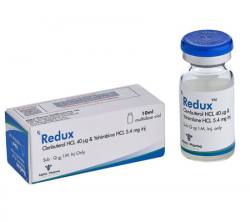
Clenbuterol & Yohimbine Inj. 40 – mg / 5.4 mg
Indications:
Redux is indicated for weight loss and weight management of local injection sites.
Redux contains a blend of Clenbuterol Hydrochloride and Yohimbine Hydrochloride, a very potent combination of a beta and alpha antagonist. Clenbuterol and Yohimbine promote fat loss through the same adrenergic system, but the effects are through very different mechanisms.
Clenbuterol is a known thermogenic shown to directly stimulate fat cells and accelerate the breakdown of triglycerides to form free fatty acids.
Yohimbine, being an antagonist of alpha-2 receptors can shift the balance of sympathetic activity to a place that measurably stimulates lypolisis.
This is further enhanced by an intrinsic ability to increase synaptic norepinephrine release, one of the body’s own natural lipolytic hormones. In effect, it serves both beta stimulating and alpha blocking properties, an ideal combination to stimulate fat loss.
Those who have used this product are proof positive that the localized reduction in adipose tissue is absolutely possible. Even in areas that seem to be extremely difficult to shed off fat. To those that believe all injectibles ultimately reach circulation and have no way of staying active in a localized area, Helio is proof that spot reduction is possible.
Redux was once recognized as a prescription appetite-suppressant medication developed for the management of obesity. Its active ingredient was dexfenfluramine, a serotonergic medicine designed to influence appetite and food intake rather than increase muscle mass or athletic performance. Although it became widely known during the 1990s weight-loss-drug era, its medical history is now primarily important as a lesson in the benefits and risks that can accompany pharmacological approaches to weight management.
Today, Redux should not be presented as a modern muscle-building medication, sports-performance product, or recommended weight-loss treatment. The medication was withdrawn from the U.S. market in 1997 after evidence raised serious concerns about cardiovascular complications, particularly heart-valve abnormalities and pulmonary hypertension.
For anyone researching this compound, understanding its original purpose, mechanism, historical effectiveness, and safety concerns is much more important than relying on outdated promotional claims.
What Was the Original Purpose?
Redux was the brand name associated with dexfenfluramine, a serotonin-related appetite suppressant. It was approved in the United States in the mid-1990s for weight management. Unlike anabolic steroids, it was not developed to increase testosterone, stimulate muscle protein synthesis, or improve strength.
Its primary objective was appetite control. Dexfenfluramine affected serotonin signaling in the brain, which could influence feelings of hunger and satiety. PubChem describes dexfenfluramine as a serotonergic agent and appetite depressant that was formerly administered for obesity treatment.
This distinction is important for anyone encountering the product in bodybuilding or fitness discussions. A compound that reduces appetite is fundamentally different from a compound intended to promote muscle growth.
The historical interest surrounding Redux therefore comes primarily from its role in obesity pharmacotherapy and the subsequent safety concerns that resulted in its withdrawal.
How Did It Work?
Dexfenfluramine was associated with serotonin pathways involved in appetite regulation. Serotonin is a neurotransmitter involved in numerous physiological processes, including mood, appetite, sleep, and gastrointestinal function.
The intended therapeutic effect was to reduce food intake by influencing the brain’s perception of satiety. In other words, the medicine was intended to help individuals consume fewer calories as part of an obesity-management strategy.
That mechanism does not translate into a direct muscle-building effect.
Muscle growth generally depends on factors such as resistance training, adequate protein and energy intake, recovery, hormonal status, and progressive training adaptation. An appetite-suppressing medication can actually work against some of these objectives if it causes a person to consume insufficient calories or protein.
Consequently, describing Redux as a muscle-building product would be scientifically misleading.
Was It Effective for Weight Loss?
Historical clinical research showed that dexfenfluramine could produce weight loss in people being treated for obesity. FDA documentation contains clinical studies examining changes in body weight and the proportion of participants achieving meaningful weight reductions.
However, effectiveness cannot be considered separately from safety.
A medicine may produce a desired physiological effect while still having an unfavorable overall risk-benefit profile. That distinction became particularly important with fenfluramine-related medications.
The history of Redux demonstrates why weight reduction alone is not enough to establish that a medication is suitable for long-term use.
Regulatory authorities ultimately determined that the cardiovascular risks associated with fenfluramine and dexfenfluramine were sufficiently serious to warrant withdrawal. A systematic review of withdrawn anti-obesity medicines identifies fenfluramine and dexfenfluramine among drugs withdrawn internationally because of adverse drug reactions.
Why Was It Withdrawn?
The major reason for the withdrawal of Redux was concern about cardiovascular disease, especially abnormalities affecting heart valves and pulmonary hypertension.
The FDA’s historical documentation states that fenfluramine and dexfenfluramine were voluntarily withdrawn from the U.S. market in November 1997 after an association was identified between these medicines and valvular heart disease.
The concerns were significant because heart-valve abnormalities can interfere with the normal movement of blood through the heart. In severe circumstances, cardiovascular disease can become life-threatening and may require medical intervention.
FDA-related documentation also records concerns involving pulmonary arterial hypertension, another potentially serious cardiovascular complication.
For this reason, Redux should not be treated like an ordinary discontinued supplement or an obsolete bodybuilding product. Its withdrawal was associated with a significant safety issue.
Importance for Muscle Growth
One of the most important points for athletes is that Redux was not an anabolic muscle-building compound.
There is no sound basis for describing dexfenfluramine as a drug that directly increases muscle protein synthesis, testosterone production, strength, or lean muscle mass.
Muscle development requires a completely different physiological strategy. Resistance exercise creates the training stimulus, while sufficient protein, calories, sleep, and recovery support adaptation. Depending on the individual’s goals, body composition, age, training experience, and nutritional status, these factors can be adjusted to promote muscle growth or fat loss.
An appetite suppressant does not replace those fundamentals.
In fact, reducing appetite can create challenges for individuals attempting to gain or preserve muscle. Someone who is eating too little may struggle to obtain adequate protein, carbohydrates, essential fats, vitamins, and minerals.
Therefore, the historical use of Redux for obesity should not be confused with a role in bodybuilding.
What About Men?
For men interested in bodybuilding, strength training, or body recomposition, Redux should not be regarded as a muscle-building medication.
It does not belong to the same pharmacological category as anabolic-androgenic steroids or testosterone therapies. Its purpose was appetite suppression rather than androgenic activity or muscle hypertrophy.
Men seeking to improve body composition generally benefit from evidence-based approaches such as progressive resistance training, adequate protein consumption, appropriate calorie management, sufficient sleep, and consistent recovery.
If a man has obesity or another condition requiring medical treatment, the appropriate approach is to discuss currently approved treatment options with a qualified healthcare professional rather than attempting to obtain a discontinued medication.
The cardiovascular history of Redux makes this particularly important.
What About Women?
The same basic principle applies to women. Redux was not a female muscle-building drug, nor was it designed to increase lean muscle tissue.
Women can develop substantial strength and muscle through progressive resistance training. Nutrition and recovery remain central components of that process.
Women also should not assume that a medication historically used for weight loss is automatically suitable for modern fat-loss goals. Medical therapies change over time as clinical evidence develops, and medications can be withdrawn when previously unrecognized risks become apparent.
Historical information about Redux therefore should not be interpreted as a recommendation for women seeking weight reduction or improved body composition.
Anyone considering medication for obesity should discuss currently available, appropriately regulated treatments with a healthcare professional.
Why the Cardiovascular Risk Matters
The most important lesson from Redux is that effectiveness must always be considered alongside safety.
The FDA documented an association between fenfluramine-related drugs and valvular heart disease. Historical scientific literature also describes abnormalities involving multiple heart valves and pulmonary hypertension.
These complications are not minor inconveniences. Cardiovascular disease can affect exercise tolerance, breathing, circulation, and overall quality of life.
For athletes, this is especially relevant because intense physical activity places additional demands on the cardiovascular system. A product with a history of serious cardiovascular concerns should never be treated casually as a fitness aid.
This is one reason modern medical practice relies heavily on regulatory review, clinical trials, post-marketing surveillance, and continued assessment of a medication’s risk-benefit profile.
Can It Still Be Used Today?
The historical product is discontinued. Drug-reference information lists the 15 mg formulation as discontinued, while FDA records document the withdrawal of dexfenfluramine products from the U.S. market.
Therefore, consumers should be extremely cautious when encountering websites, social-media advertisements, or bodybuilding forums claiming to sell authentic Redux.
A product being advertised online under an old pharmaceutical name does not establish that it is genuine, safe, legally marketed, or equivalent to the original medicine.
Counterfeit or improperly manufactured products can introduce additional risks because the stated ingredient, concentration, purity, and manufacturing conditions may not be reliable.
Anyone who encounters an old prescription product should consult a pharmacist or physician before considering its use.
Redux and Modern Weight Management
Modern obesity treatment has evolved considerably since the 1990s.
Healthcare professionals now consider factors such as body-mass index, metabolic health, cardiovascular risk, other medical conditions, medications, lifestyle factors, and individual treatment goals when determining an appropriate strategy.
Medication, when appropriate, is only one component of treatment. Nutrition, physical activity, sleep, behavioral support, and management of underlying medical conditions can also play important roles.
The historical experience with Redux illustrates why modern therapies must undergo careful evaluation before and after approval.
The goal is not simply to find a drug that produces weight loss. The goal is to identify interventions in which the expected health benefits outweigh the potential risks for appropriately selected patients.
A Better Approach to Muscle and Fat Loss
People interested in simultaneously improving muscle development and reducing body fat should generally focus on sustainable fundamentals rather than discontinued appetite suppressants.
Resistance training provides the stimulus for muscular adaptation. Protein provides amino acids needed for tissue maintenance and repair. Adequate energy intake supports training and recovery, while calorie control can be used strategically when fat loss is the objective.
Sleep is another important component. Poor recovery can interfere with training performance, appetite regulation, and overall well-being.
For beginners, a structured resistance-training program built around major movement patterns can provide an effective foundation. Experienced lifters can progressively increase training volume, intensity, or load while monitoring recovery.
Nutrition should likewise be individualized. Someone attempting to gain muscle generally needs a different calorie strategy from someone attempting to lose body fat.
These principles remain relevant regardless of sex.
Important Safety Considerations
Anyone researching Redux should understand several important points.
First, the historical medication is not an approved modern bodybuilding treatment.
Second, it should not be described as a testosterone booster or anabolic agent.
Third, the drug’s withdrawal was connected to serious cardiovascular safety concerns.
Fourth, purchasing an old or purportedly equivalent product from an unverified online source carries additional uncertainty.
Finally, people who previously used fenfluramine-related medications and have concerns about possible cardiovascular effects should speak with a healthcare professional. Symptoms such as unexplained shortness of breath, chest discomfort, fainting, unusual swelling, or reduced exercise tolerance warrant appropriate medical evaluation rather than self-treatment.
Final Assessment
Redux occupies an important place in the history of weight-loss medicine, but its historical importance should not be confused with modern suitability.
Dexfenfluramine was developed as an appetite suppressant for obesity and could contribute to weight reduction. It was not designed to build muscle, increase strength, enhance testosterone, or provide bodybuilding benefits. Historical evidence and regulatory records subsequently identified serious cardiovascular concerns, leading to its withdrawal from the U.S. market in 1997.
For both men and women, there is no credible reason to regard the compound as a modern muscle-building solution. People seeking better body composition should instead focus on resistance training, appropriate nutrition, recovery, and medically supervised options when treatment for obesity is indicated.
The most valuable takeaway from the history of Redux is therefore not that it was a powerful fitness drug, but that pharmaceutical effectiveness must always be balanced against safety.
For additional authoritative information, readers can consult the FDA’s historical drug records, PubChem’s dexfenfluramine record, and published medical literature concerning withdrawn anti-obesity medications. These resources provide a more reliable foundation than promotional claims made by unverified sellers.
Medical disclaimer: This article is for educational and SEO content purposes only. It does not recommend using dexfenfluramine or any discontinued prescription medication. Medication decisions should be made with a qualified healthcare professional using current medical guidance.

Reviews
There are no reviews yet.