

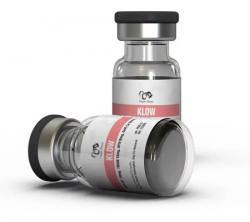
Klow 80mg contains:
•GHK-Cu – 50mg
•TB500 – 10mg
•BPC157 – 10mg
•KPV – 10mg
Klow 80 mg is a scientifically advanced peptide blend engineered specifically to combat these challenges. Combining four powerful, synergistic compounds – KPV, BPC-157, TB-500 and GHK-Cu—KLOW offers a comprehensive solution for accelerating recovery, repairing damaged tissues, and reducing systemic inflammation.
Effects of KLOW 80 mg
The power of KLOW lies in the synergistic effects of its four active ingredients. This isn’t just a single-target solution; it’s a systemic recovery protocol.
BPC-157: Known as the “Body Protecting Compound,” it significantly accelerates the healing of muscles, tendons, ligaments, and even the gastrointestinal tract. It promotes angiogenesis (formation of new blood vessels), ensuring injured areas receive vital nutrients.
TB-500 (Thymosin Beta-4): This peptide enhances cell migration, tissue repair and flexibility. It is particularly effective for healing joint and connective tissue injuries, making it invaluable for those with chronic shoulder, knee, or elbow pain.
GHK-Cu: A copper-binding peptide with powerful anti-inflammatory and antioxidant properties. Beyond healing, it promotes skin tightening, wound repair, and can even improve hair health and density, contributing to overall well-being.
KPV: A potent anti-inflammatory peptide, KPV is especially effective for reducing inflammation in the gut and skin. This can lead to improved nutrient absorption and a reduction in systemic inflammation, creating a better internal environment for growth and recovery.
Together, these peptides make Klow an indispensable tool for overcoming training plateaus caused by nagging injuries and for reducing downtime between intense sessions.
Dosage:
Klow 80 mg is supplied as a lyophilized powder that must be reconstituted with Bacteriostatic Water before use.
Standard Healing Protocol: 1 mg to 2 mg per day, split into two doses (e.g., 500 mcg to 1,000 mcg twice daily).
Maintenance/Low-Inflammation Protocol: 500 mcg to 1 mg per day.
To ensure accurate dosing, a precise insulin syringe is required. The vial contains a total of 80 mg. Once reconstituted, the solution should be refrigerated and used within a few weeks.
Cycle and Stacking:
Klow is incredibly versatile and can be used in several ways. A typical cycle lasts 4 to 8 weeks. For maximum results, it can be seamlessly integrated into any anabolic cycle to mitigate side effects and enhance performance.
Standalone Healing Cycle: Run Klow at 1-2 mg/day for 6-8 weeks to focus solely on injury recovery and reducing systemic inflammation.
Stack with Growth Hormone Secretagogues: For enhanced systemic recovery and fat loss, stack Klow with CJC 1295 No DAC/Ipamorelin. This combination powerfully stimulates your body’s own GH production.
Support during Cutting Cycles: When running a cutting stack like Clenbuterol and T3, adding Klow can help protect joints and connective tissues that become vulnerable in a caloric deficit.
Injury Prevention during Heavy Blasts: Incorporate Klow into a high-volume bulking cycle with compounds like Deca 300 or Testabol 400 to proactively support joint health and accelerate muscle repair.
Post-Cycle Therapy (PCT) Support: Use Klow during your PCT with Levitra to aid the body’s overall recovery and maintain a positive nitrogen balance when hormone levels are fluctuating.
Side Effects:
Klow is generally well-tolerated with a high safety profile. The peptides are comprised of natural amino acids and are not known to cause significant androgenic or hormonal side effects. However, some users may experience:
– Mild irritation, redness, or itching at the injection site.
– Temporary fatigue or lethargy, particularly when first starting.
– Mild headache or dizziness.
What the Formulation Is
Klow is best understood as a research-use peptide formulation rather than a conventional pharmaceutical drug. The most commonly reported composition is an 80 mg research vial containing GHK-Cu, BPC-157, TB-500, and KPV. Some vendors may use different ratios, so researchers should always examine the exact product label and batch-specific certificate of analysis instead of assuming that every vial has the same composition.
The scientific rationale behind the formulation is interesting because the four components are studied for different biological activities. GHK-Cu is a copper-binding peptide investigated in relation to extracellular-matrix remodeling and skin biology. BPC-157 has been investigated primarily in preclinical models involving tissue repair and vascular signaling. TB-500 is associated with research into thymosin-beta-4-related cellular migration and wound-repair processes. KPV, a small peptide related to alpha-melanocyte-stimulating hormone, has been studied for effects on inflammatory signaling.
These mechanisms make the formulation scientifically interesting, but they should not be confused with proof of clinical effectiveness. Research findings for individual peptides cannot automatically be transferred to a combination product.
Why the Four Components Matter
A major reason researchers are interested in this blend is the possibility of examining several biological processes within the same experimental framework. Tissue repair is not a single event. It involves inflammation, cell migration, extracellular-matrix remodeling, vascular responses, and subsequent tissue organization. Each of the four peptides has been studied in one or more of these areas.
GHK-Cu is particularly notable for its relationship with copper-dependent biological processes and extracellular-matrix activity. Laboratory and preclinical research has examined its influence on collagen, elastin, glycosaminoglycans, and cellular signaling. These findings have helped make copper peptides relevant to skin and regenerative-biology research.
BPC-157 has attracted substantial interest because animal and laboratory studies have investigated its possible effects on vascular responses, tissue repair, and gastrointestinal and musculoskeletal models. However, the strongest evidence remains preclinical, meaning that positive observations in experimental animals do not establish that the same results will occur in humans.
TB-500 is commonly discussed in connection with thymosin-beta-4 research. Thymosin-beta-4 has been studied for cellular migration, wound healing, angiogenesis, and cytoskeletal activity. Again, the distinction between research findings involving thymosin-beta-4 and claims about a specific TB-500 formulation is important.
KPV adds another research dimension. Experimental studies have explored its influence on inflammatory signaling, including pathways associated with NF-kB and inflammatory cytokines. This makes it especially relevant to laboratory investigations where inflammation is one of the variables being studied.
Potential Research Importance
The importance of the formulation is therefore primarily scientific rather than established therapeutic. A multi-peptide formulation can provide researchers with a way to investigate several pathways in a coordinated experimental model. It may be useful for studying how matrix remodeling, cellular movement, inflammatory signaling, and repair-related responses interact.
This distinction matters. A product can be scientifically interesting without being clinically proven. Researchers should avoid interpreting mechanistic evidence as proof that a product will accelerate recovery, eliminate pain, build muscle, improve athletic performance, or treat disease.
For people interested in regenerative medicine, the broader importance of this research area lies in understanding how the body coordinates repair. Tissue recovery depends on communication between cells, blood vessels, extracellular structures, and immune pathways. Studying these systems separately and together may eventually help scientists develop better treatments. However, that future possibility should not be presented as an established benefit of the blend itself.
How Effective Is Klow?
The most accurate answer is that the effectiveness of Klow as a combined product has not been clinically established. Available information describes the formulation as a research blend, and current literature does not provide a robust controlled human trial demonstrating that the four-peptide combination improves a specific medical outcome.
This is one of the most important points to include in any responsible product description. Evidence surrounding individual ingredients may explain why researchers are interested in them, but it does not prove that combining them creates an additive or synergistic effect.
For example, if a laboratory study suggests that one peptide influences cellular migration and another affects inflammatory signaling, it is scientifically reasonable to investigate whether those mechanisms interact. It is not scientifically reasonable to conclude, without a controlled combination study, that the resulting blend will necessarily produce faster healing or better outcomes.
The quality of evidence also matters. Cell-culture experiments and animal studies can reveal mechanisms and generate hypotheses, but they do not replace randomized human clinical trials. Human pharmacokinetics, immune responses, interactions, manufacturing quality, and long-term safety can differ substantially from experimental models.
A careful evidence-based product description should also acknowledge uncertainty around long-term exposure, interactions among the individual peptides, and differences between research preparations. These questions are especially important because a fixed blend may expose experimental systems to multiple active molecules at the same time. Future work should therefore evaluate both individual components and the complete formulation under standardized conditions, with transparent reporting of outcomes and adverse findings.
Safety and Regulatory Considerations
Klow should not be described as an approved medication. Current sources identify the formulation as research-only, and the individual components do not have FDA approval for a human therapeutic indication. The combination itself also lacks the type of controlled clinical evidence normally required to establish safety and efficacy for a medicine.
This means buyers and researchers should be cautious about websites that present the formulation as a proven treatment or make guaranteed claims about healing, pain reduction, muscle growth, fat loss, anti-aging, or disease treatment. Such statements go beyond what the evidence can support.
Another important consideration is product quality. Research peptides can vary in purity, identity, concentration, sterility, and contamination risk. A certificate of analysis can provide useful information about a particular batch, but a COA should be evaluated carefully and should not be treated as proof of clinical safety. Researchers should consider the testing method, laboratory identity, sample identification, reported purity, and whether the documentation corresponds to the exact batch being studied.
External scientific and regulatory resources are useful when evaluating peptide research. Researchers can consult the U.S. Food and Drug Administration for information about unapproved drugs and compounding considerations, and PubMed for peer-reviewed biomedical literature.
FDA Drug Information and Regulatory Resources
PubMed Biomedical Research Database
Who Is This Research Relevant To?
The formulation may be of interest to laboratories investigating tissue repair, inflammation, wound biology, extracellular-matrix remodeling, regenerative biology, and related cellular pathways. It may also interest scientists comparing individual peptides with multi-component experimental systems.
For professional researchers, the value lies in reproducibility and careful measurement. Experiments should define the exact material being studied, document its analytical characteristics, use appropriate controls, and distinguish observations from hypotheses. If a study compares a combination against individual components, the design can help determine whether the combined formulation produces an effect that is greater than, equal to, or different from its separate components.
For consumers, however, the situation is different. Research-only labeling means the product should not be treated as a substitute for medical care or as a self-directed therapy. Anyone considering an experimental peptide for a health problem should discuss evidence-based options with a qualified healthcare professional.
Research Value Versus Marketing Claims
One of the biggest challenges surrounding peptide products is the gap between scientific language and marketing language. Terms such as “regeneration,” “repair,” “anti-inflammatory,” and “recovery” can sound definitive even when they describe only laboratory observations.
A responsible description should therefore separate three levels of evidence.
First is mechanism. A peptide may interact with a receptor, signaling pathway, enzyme, or cellular process. This helps explain why scientists study it.
Second is preclinical evidence. An effect may be observed in cells or animals. This can be promising, but it remains preliminary.
Third is clinical evidence. A properly designed human study can determine whether an intervention produces a meaningful benefit while also identifying risks and limitations.
Klow currently belongs primarily to the first two categories. The biological rationale is substantial enough to justify research interest, but the combination lacks the clinical evidence required to call it an effective human treatment.
Why Independent Testing Matters
Another important part of evaluating Klow is analytical transparency. Research laboratories should look for batch-specific documentation rather than relying solely on promotional claims. High-quality documentation can include chromatographic purity testing, mass-spectrometry identity confirmation, and other appropriate analytical measurements.
Independent testing is especially valuable because a research compound’s label does not guarantee its actual contents. A well-documented batch gives researchers greater confidence that the material being investigated corresponds to the stated formulation.
Even so, purity is only one part of scientific quality. A highly pure compound can still be unsuitable for human administration, and purity data do not establish clinical efficacy. This distinction is essential when writing educational content about research peptides.
The Future of Peptide Research
Interest in peptide science continues to grow because peptides can influence highly specific biological processes. Researchers are investigating their roles in inflammation, tissue remodeling, cellular signaling, metabolic pathways, and regenerative biology.
The potential value of Klow research lies in asking better scientific questions. Does combining different peptides change the response compared with individual components? Are there interactions between repair and inflammatory pathways? Which biological markers change first? What concentrations produce measurable effects in controlled models? What safety signals appear with repeated exposure?
These are research questions, not promises of treatment.
As evidence develops, controlled studies could clarify whether multi-peptide approaches have genuine advantages. Until that evidence exists, responsible communication should emphasize what has been observed, what remains uncertain, and what has not yet been tested.
Conclusion
Klow represents an intriguing example of how modern peptide research is moving toward multi-component experimental formulations. By bringing together GHK-Cu, BPC-157, TB-500, and KPV, the blend is designed around several distinct areas of biological interest, including matrix remodeling, cellular migration, tissue-repair signaling, and inflammation research.
Its importance should be understood in the context of scientific investigation rather than established medical treatment. Research into the individual components provides reasons to study their mechanisms, but the combined formulation has not been adequately tested in controlled human trials. As a result, claims about guaranteed healing, enhanced performance, muscle development, or disease treatment would be unsupported.
For researchers, the most useful approach is evidence-first evaluation: verify the composition, review the certificate of analysis, consult peer-reviewed literature, use appropriate experimental controls, and distinguish preclinical observations from clinical outcomes. For consumers, the central message is equally important: a research-use peptide blend is not automatically a safe or effective medicine.
Resources
For authoritative background, consult the U.S. Food and Drug Administration’s information on unapproved drugs and regulatory issues, and search PubMed for peer-reviewed studies on GHK-Cu, BPC-157, thymosin-beta-4, and KPV. Current product documentation also emphasizes that the blend is intended for laboratory research rather than human consumption.
Reviews
There are no reviews yet.